
Smart heating · Homes and businesses in Surrey and the surrounding areas
Every room at the right temperature, only when it's needed.
Ordinary controls rely on one thermostat in the hallway, radiator valves that measure the hot air right next to the radiator, and timers that heat empty rooms. This fixes all three.
How it works
- 01 A smart valve on every radiator Each radiator can be turned up or down on its own, so every room is controlled separately.
- 02 A sensor in every room A valve's own sensor sits right on the hot radiator, so it thinks the room is warm as soon as the radiator heats up, and shuts itself off too early. An inexpensive separate thermometer (around £10), a few feet away, is linked to the valve and tells it the real temperature of the room.
- 03 A private wireless network The devices talk over a Zigbee mesh that covers the whole building, run by open-source software on site.
- 04 Rules built around you Software I write for your building decides which rooms need heat, when, and how much, and only fires the boiler when it's needed. The rules can be whatever suits you and your building. You control it from an app on your phone.
Proof
It heats my own home
Every radiator in my house has a smart valve, every room has its own sensor, and my own software runs the heating. Overnight, the baby's room and our bedroom are never allowed to drop below a set temperature, whatever else is going on, while the downstairs rooms are only kept above a minimum. The rooms we use first thing are warmed up ready for when we come down.
During the day, the boiler only comes on when enough radiators are asking for heat, and they're far enough below the temperature they want for it to be worth it. So it isn't fired up just because one room is half a degree short. Those are the rules that suit my house. Yours can be whatever suits yours, and I'll build them for you.
It didn't start that way. I began with an ordinary Hive thermostat on the boiler, then added a few Hive radiator valves, and only moved to Sonoff valves when I built my own system. So if you already have a Hive thermostat, with or without Hive valves, you don't need to rip it all out and start again. I can upgrade what you have. My heating is no longer connected to Hive's cloud at all, so there's no subscription, and nobody who broke into Hive's servers could control it.
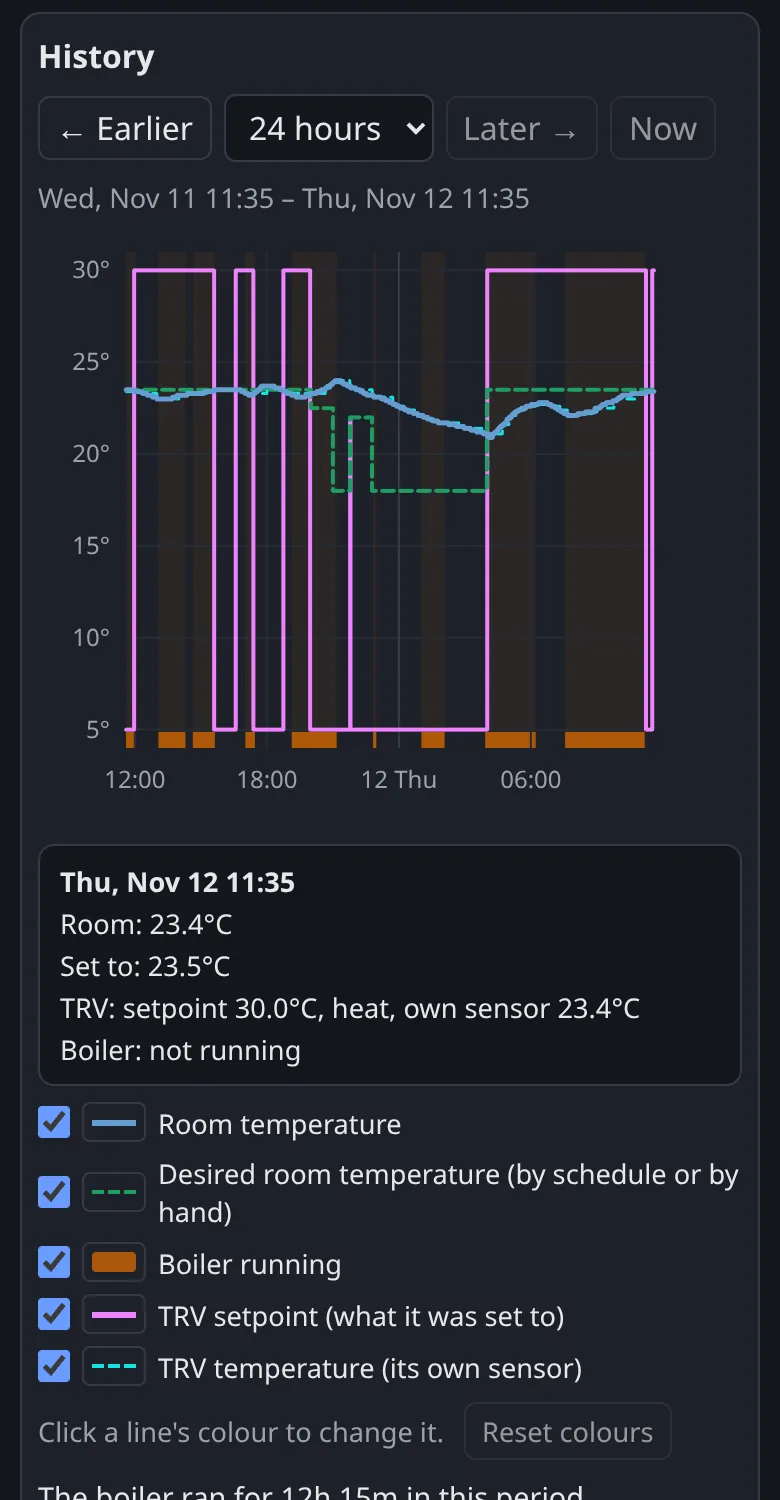
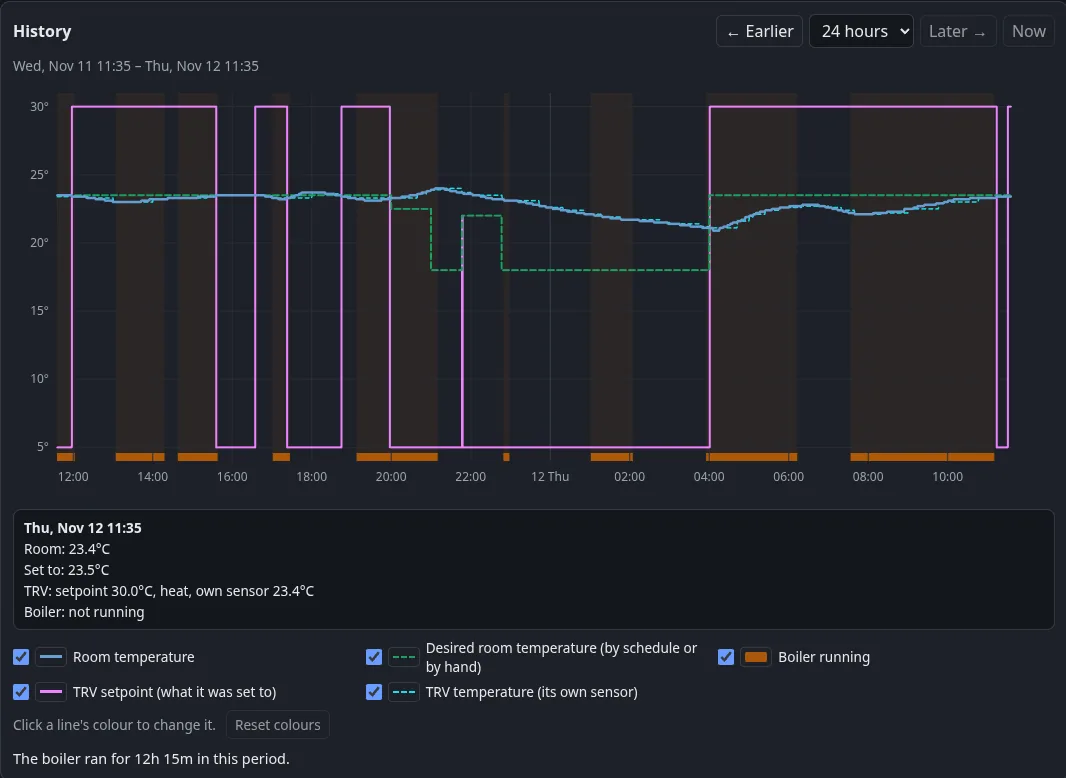
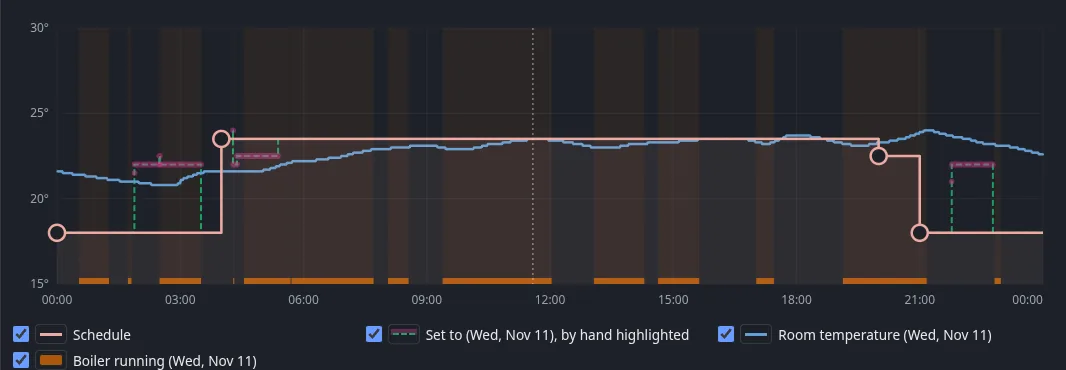
With every room controlled separately, my boiler can run at a much lower temperature (50 °C) and simply run for longer, gently keeping each room where it should be instead of blasting heat in short bursts. A condensing boiler is more efficient at lower temperatures, so this cuts my energy bills, and it's why the boiler is on for so much of the day in the graphs below.
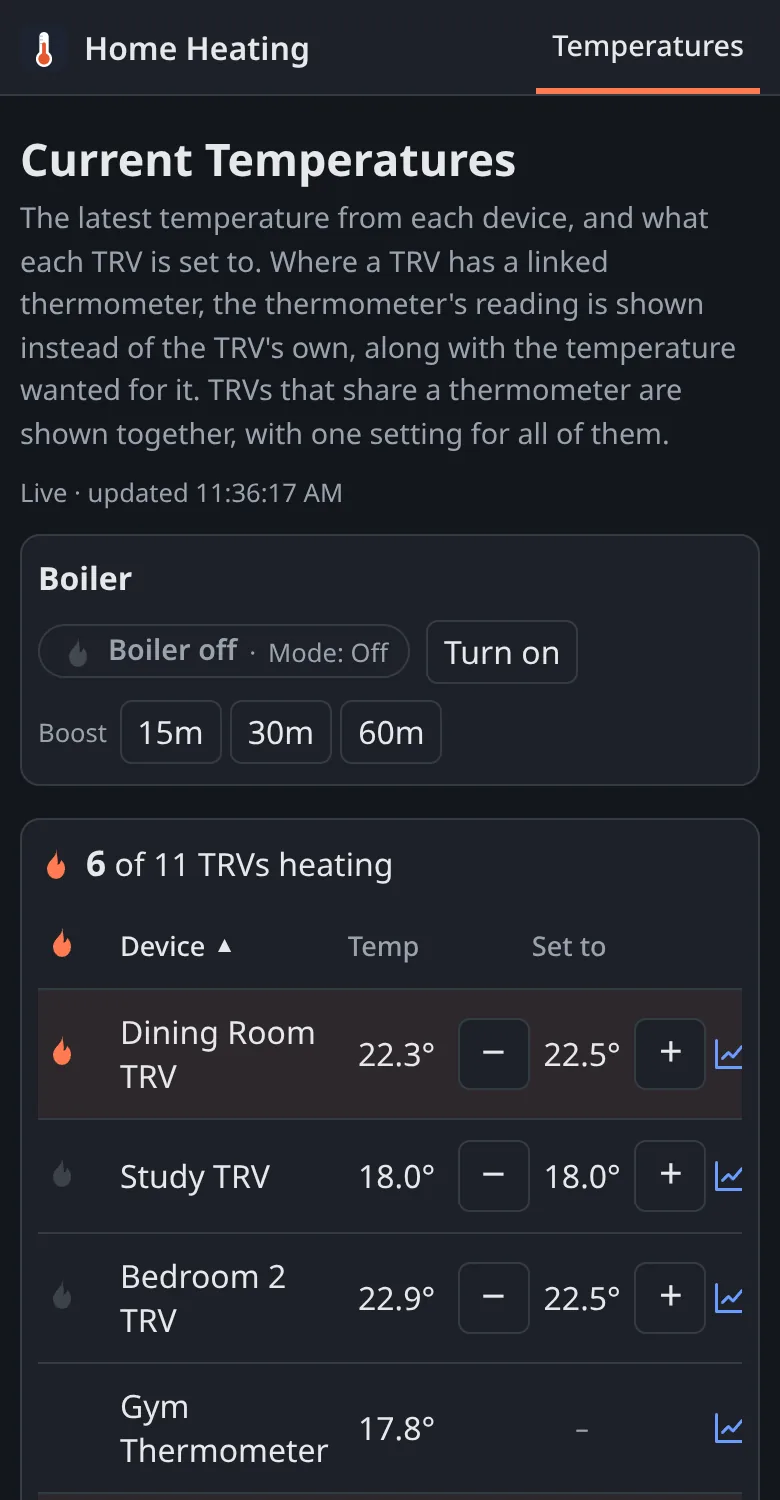
Because the phone is where it gets used most, I designed the controls for a phone screen first. It installs as an app (a progressive web app), so it opens from an icon on the home screen instead of a page in the browser.
What the data shows you
The system records every room's temperature, what each valve was told to do and when the boiler ran. That shows you how your building really behaves, and what's worth fixing.
Rooms that lose their heat
You can see which rooms cool down fastest once the heating stops, so you know where insulation or draught-proofing would make the biggest difference.
Where the heat really goes
In my house, once it's warmed up in the morning, it's almost only the downstairs rooms that need heat during the day. The upstairs rooms are kept warm by the heat rising from below, so their radiators can stay off.
Radiators that "leak"
Some of my radiators warmed up whenever the boiler ran, even though their valves were meant to be shut. Their old valves were letting water through. The ones I'd fitted with Drayton valves didn't have the problem, so I knew exactly which to replace. It isn't a big job for a plumber, as neither the radiators nor the pipes need moving.
Radiators that are too big
An oversized radiator overshoots and makes its room too hot. Running the boiler at a lower temperature helps, and with Sonoff valves I can also cap how far the valve opens, so the radiator never gives out more heat than the room needs.
Radiators that are too small
An undersized radiator struggles to keep up. You can run the boiler hotter, at the cost of efficiency, or add a fan. My kitchen radiator is a tall, narrow one to save space, and its heat tended to sit beside it rather than reach the rest of the room. So a small fan on a smart plug now switches on when the radiator has been heating for a while, and off again once the room is nearly warm enough, or a few minutes after the boiler stops. It gets far more heat out of the radiator, and spreads it to where the thermometer actually is.
Which hardware is worth paying for
The valve on the radiator itself is worth spending money on, as a cheap one lets water through even when it's shut. The smart head on top is the opposite. Expensive branded ones, such as Hive's, have their own built-in logic that fights against a system trying to control them, and can't have how far they open capped. Much less expensive Sonoff Zigbee heads simply do what they're told, and work better.
Screenshots from my own system
Why run it yourself
Your building, your equipment, your data
Private
Readings and footage stay on equipment in your building. Nothing is sent to a company you've never met.
No subscriptions
Everything runs on open-source software, so there's no monthly fee to keep it working.
Safe from someone else's data breach
Cloud-connected heating and cameras can be controlled by anyone who breaks into the manufacturer's servers. Your system isn't connected to them at all, so if they're ever hacked, nobody can take control of your heating or look through your cameras.
Keeps working
Because nothing depends on a cloud service, it keeps running even when your internet connection doesn't.
Secure access from anywhere
A VPN app on your phone gives you a private, encrypted connection home, so you can adjust the heating and check the cameras wherever you are. Neither system is ever left open on the internet for anyone to attack.
Who it's for
Homes, rented properties and workplaces
Homes
Comfortable bedrooms all night, warm rooms ready for the morning, and rooms nobody is using turned right down.
Rented properties
Each room heated to a sensible level on its own, rather than one thermostat that's always being fought over.
Offices and small businesses
Rooms warmed up before people arrive, and empty spaces kept low until they're needed.
I'm happy to show you it running in my own home, so you can see exactly what you'd be getting.
Interested?
Tell me about your building and how you use it, and we can talk through what would work. Smart home systems are set up in person, so I only take these on in Surrey and the surrounding areas.
You buy the hardware yourself, directly from the supplier, so you pay the shop price with no markup from me. I'll give you a list of the equipment I support. My time setting it all up is charged at my usual hourly rate.
Book a free call